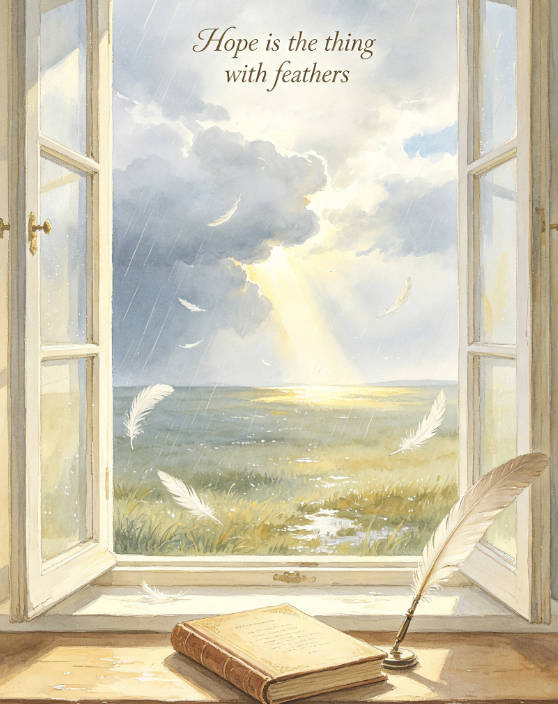
"Hope" is the thing with feathers
Emily Dickinson · c. 1861 · Common metre, slant rhyme
"Hope" is the thing with feathers - That perches in the soul - And sings the tune without the words - And never stops - at all - And sweetest - in the Gale - is heard - And sore must be the storm - That could abash the little Bird That kept so many warm - I've heard it in the chillest land - And on the strangest Sea - Yet - never, in Extremity, It asked a crumb - of me.
Meaning
Hope is defined not as an emotion but as a small resident creature: wordless, tireless, and — crucially — free of charge.
Analysis
Dickinson does not say hope is like a bird. She says it is 'the thing with feathers', deferring the noun so the reader meets the sensation before the metaphor. That one-word delay is the entire technique of the poem in miniature.
The dashes function as breath and hesitation at once. They keep the definition provisional, as though the speaker is still working it out on the page, which is exactly what makes an abstract noun like hope feel physically present.
The last stanza is the moral turn. After the gale and the storm, the surprise is economic: the bird 'never... asked a crumb'. Hope, in Dickinson's ledger, is the only comfort that arrives without a debt attached.
Craft notes for your own writing
- Delay the metaphor's noun to create curiosity.
- Let punctuation carry emotional hesitation.
- End on a small, concrete, unexpected detail rather than a grand statement.