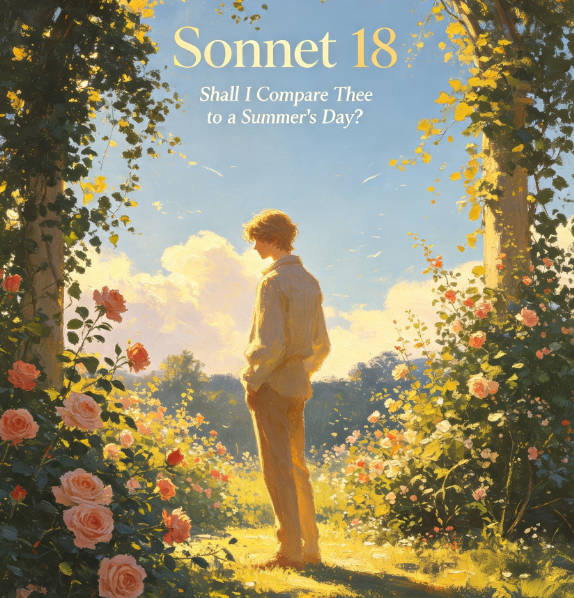
Sonnet 18: Shall I Compare Thee to a Summer's Day?
William Shakespeare · 1609 · Shakespearean sonnet, iambic pentameter
Shall I compare thee to a summer's day? Thou art more lovely and more temperate: Rough winds do shake the darling buds of May, And summer's lease hath all too short a date; Sometime too hot the eye of heaven shines, And often is his gold complexion dimm'd; And every fair from fair sometime declines, By chance or nature's changing course untrimm'd; But thy eternal summer shall not fade, Nor lose possession of that fair thou ow'st; Nor shall death brag thou wander'st in his shade, When in eternal lines to time thou grow'st: So long as men can breathe or eyes can see, So long lives this, and this gives life to thee.
Meaning
A love poem that quietly turns into a poem about poetry: the beloved outlives summer not because beauty lasts, but because the written line does.
Analysis
The opening question is a trap the poem sets for itself. Shakespeare proposes the most conventional compliment available — you are like a summer's day — and then spends eight lines proving the comparison is an insult. Summer is windy, short-leased, too hot, and dimmed by cloud. The beloved is 'more temperate', a word that carries both weather and temperament.
The volta at line nine swaps meteorology for metaphysics. 'But thy eternal summer shall not fade' is a promise no lover can keep, so the poem transfers the promise to the artefact itself. The final couplet is almost brazenly self-aware: the survival of the beloved depends entirely on the survival of these fourteen lines.
Read today, the poem reads like the first great argument for media permanence. It is not naive romance; it is a wager that language is more durable than skin, and four centuries of readers have kept paying out on that bet.
Craft notes for your own writing
- Set up a cliché deliberately, then dismantle it — the dismantling is the poem.
- Reserve your strongest claim for the final two lines.
- Use concrete weather to carry abstract emotion.