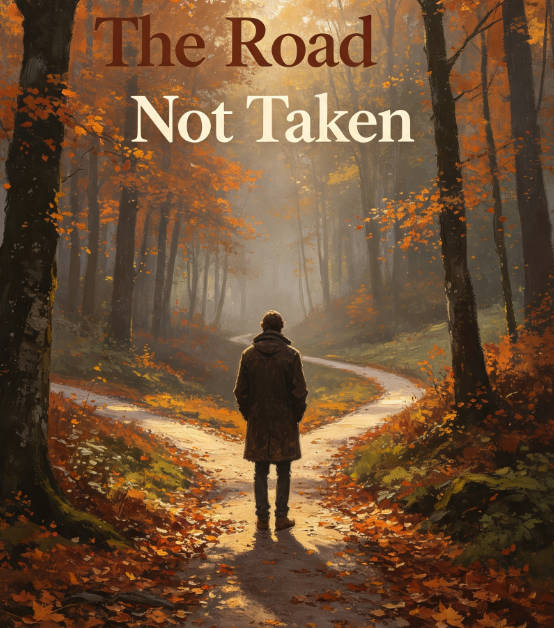
The Road Not Taken
Robert Frost · 1916 · Four quintains, ABAAB
Two roads diverged in a yellow wood, And sorry I could not travel both And be one traveler, long I stood And looked down one as far as I could To where it bent in the undergrowth; Then took the other, as just as fair, And having perhaps the better claim, Because it was grassy and wanted wear; Though as for that the passing there Had worn them really about the same, And both that morning equally lay In leaves no step had trodden black. Oh, I kept the first for another day! Yet knowing how way leads on to way, I doubted if I should ever come back. I shall be sorry I told this with a sigh Somewhere ages and ages hence: Two roads diverged in a wood, and I— I took the one less traveled by, And that has made all the difference.
Meaning
Not a celebration of nonconformity, but a study of how memory edits a coin-flip into a destiny.
Analysis
The poem states plainly, twice, that the two roads were worn 'really about the same'. Any reading that treats it as an anthem of individualism has skipped the middle stanza — which is itself the poem's point about how people read their own lives.
The tell is the future tense in the final stanza. The speaker predicts the story he will tell 'ages and ages hence', complete with a rehearsed sigh. Frost shows narrative self-mythology forming in real time.
The dash after 'and I—' is the most famous hesitation in American poetry. It is the sound of a person choosing which version of himself to hand to posterity.
Craft notes for your own writing
- Contradict your own conclusion earlier in the poem; let the reader notice.
- Shift tense to expose how a memory will be retold.
- A single dash can do the work of a stanza.