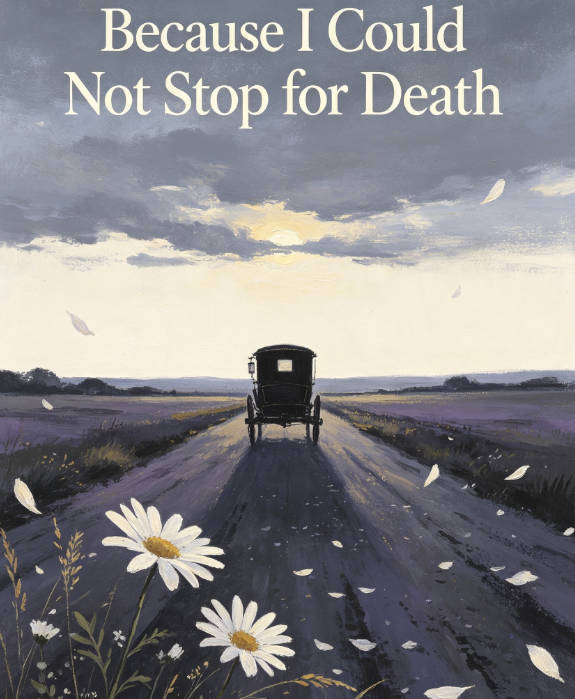
Because I Could Not Stop for Death
Emily Dickinson · c. 1863 · Common metre, slant rhyme
Because I could not stop for Death— He kindly stopped for me— The Carriage held but just Ourselves— And Immortality. We slowly drove—He knew no haste And I had put away My labor and my leisure too, For His Civility— We passed the School, where Children strove At Recess—in the Ring— We passed the Fields of Gazing Grain— We passed the Setting Sun— Or rather—He passed Us— The Dews drew quivering and chill— For only Gossamer, my Gown— My Tippet—only Tulle— We paused before a House that seemed A Swelling of the Ground— The Roof was scarcely visible— The Cornice—in the Ground— Since then—'tis Centuries—and yet Feels shorter than the Day I first surmised the Horses' Heads Were toward Eternity—
Meaning
Death is not a violent interruption but a polite escort — and the speaker's shock is not at dying, but at how ordinary the journey felt.
Analysis
Dickinson's masterstroke is the word 'kindly'. Death is not a robber but a gentleman caller who picks her up because she was too busy to come on her own. The domesticity of the metaphor is what makes it unsettling.
The stages of the carriage ride — school, grain, sunset — are the stages of a life passing in review: childhood, maturity, decline. The speaker sees them but does not comment, as though memory itself has gone passive.
The 'House' that is a grave is described without alarm. The chill comes later, in the final stanza, when centuries feel shorter than a single afternoon. That distortion of time is the only evidence that something has gone permanently wrong.
Craft notes for your own writing
- Pair a terrifying subject with a polite tone; the contrast does the work.
- Let a journey structure carry an argument about life's stages.
- Delay the realisation — the speaker does not know where she is going until the final stanza.