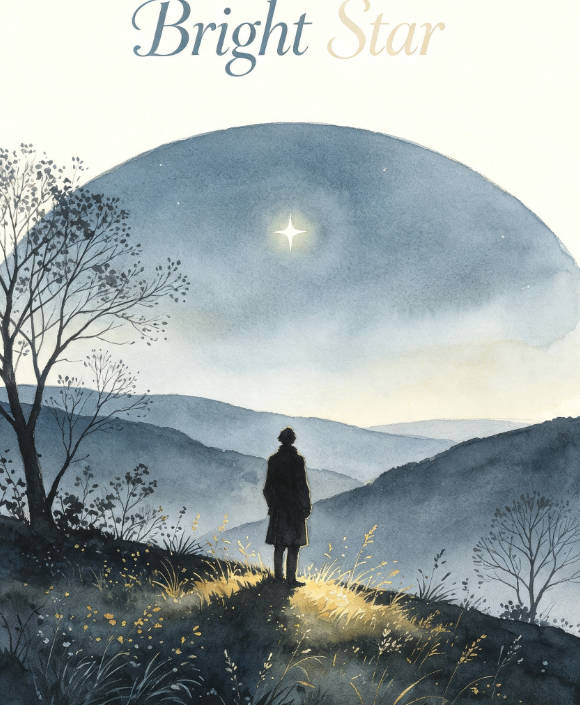
Bright Star
John Keats · 1819 · Shakespearean sonnet
Bright star, would I were stedfast as thou art— Not in lone splendour hung aloft the night And watching, with eternal lids apart, Like nature's patient, sleepless Eremite, The moving waters at their priestlike task Of pure ablution round earth's human shores, Or gazing on the new soft-fallen mask Of snow upon the mountains and the moors— No—yet still stedfast, still unchangeable, Pillow'd upon my fair love's ripening breast, To feel for ever its soft fall and swell, Awake for ever in a sweet unrest, Still, still to hear her tender-taken breath, And so live ever—or else swoon to death.
Meaning
A lover wishes for the star's permanence, but not its loneliness: he wants to be steadfast the way the star is — only if steadfastness means resting on his beloved, not hanging alone above the world.
Analysis
The poem's argument turns on the word 'No'. Keats spends the octave admiring the star's steadfastness, then refuses it. The star's permanence is lonely, celibate, and cold; the speaker wants permanence only if it comes with human warmth.
The image of the waters performing 'pure ablution' gives the star a priestlike role — it watches but does not touch. Keats contrasts this distant purity with the 'soft fall and swell' of the beloved's breast, which is bodily, rhythmic, and intimate.
The final line is a double ending: 'live ever' or 'swoon to death'. Keats cannot have both steadfastness and love without paying for it, and the poem suggests the price might be death — not as tragedy, but as the only state where intensity can remain unbroken.
Craft notes for your own writing
- Admire something, then refuse it; the refusal is the poem's real subject.
- Contrast a cold, distant image with a warm, bodily one.
- End on an alternative — 'this or that' — when the poem cannot resolve.