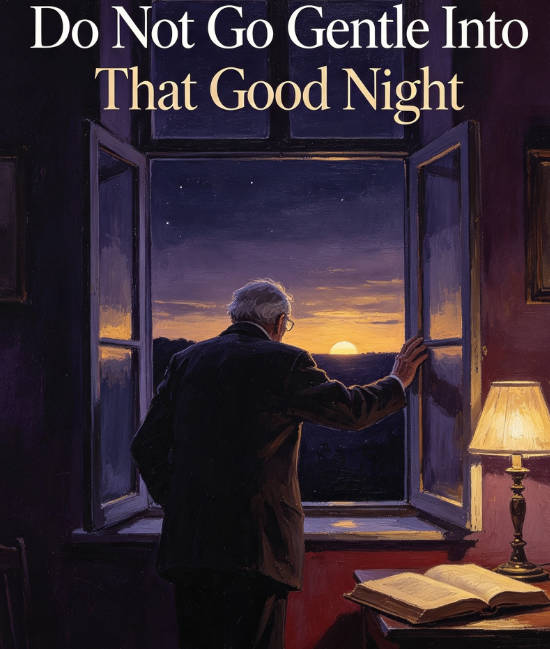
Do Not Go Gentle Into That Good Night
Dylan Thomas · 1951 · Villanelle, nineteen lines
Do not go gentle into that good night, Old age should burn and rave at close of day; Rage, rage against the dying of the light. Though wise men at their end know dark is right, Because their words had forked no lightning they Do not go gentle into that good night. Good men, the last wave by, crying how bright Their frail deeds might have danced in a green bay, Rage, rage against the dying of the light. Wild men who caught and sang the sun in flight, And learn, too late, they grieved it on its way, Do not go gentle into that good night. Grave men, near death, who see with blinding sight Blind eyes could blaze like meteors and be gay, Rage, rage against the dying of the light. And you, my father, there on the sad height, Curse, bless, me now with your fierce tears, I pray. Do not go gentle into that good night. Rage, rage against the dying of the light.
Meaning
A son pleading with his dying father to resist death — not because survival is possible, but because the fight itself is the last act of love he can witness.
Analysis
The villanelle form, with its two refrains circling endlessly, is the poem's argument made structural: the repetition enacts a refusal to let go, a voice that keeps coming back to the same desperate demand.
Thomas catalogues four types of men — wise, good, wild, grave — each of whom realises, too late, that their life fell short. The father is the fifth, the personal case that breaks through the abstraction.
'Rage, rage' is not anger at death but at the passivity it invites. The poem's power lies in how unreasonable the request is: the speaker knows the father will die, and asks him to fight anyway.
Craft notes for your own writing
- Choose a form whose repetition mirrors the emotional situation.
- Build through examples before arriving at the personal case.
- An unreasonable demand can be more loving than a reasonable acceptance.