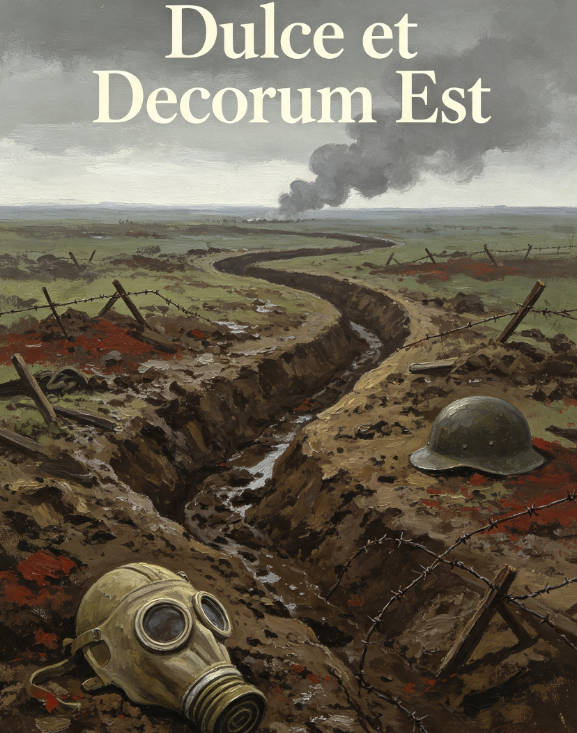
Dulce et Decorum Est
Wilfred Owen · 1917 · Two parts, broken sonnet-like stanzas
Bent double, like old beggars under sacks, Knock-kneed, coughing like hags, we cursed through sludge, Till on the haunting flares we turned our backs And towards our distant rest began to trudge. Men marched asleep. Many had lost their boots But limped on, blood-shod. All went lame; all blind; Drunk with fatigue; deaf even to the hoots Of disappointed shells that dropped behind. Gas! GAS! Quick, boys!—An ecstasy of fumbling, Fitting the clumsy helmets just in time; But someone still was yelling out and stumbling And flound'ring like a man in fire or lime... Dim, through the misty panes and thick green light, As under a green sea, I saw him drowning. In all my dreams, before my helpless sight, He plunges at me, guttering, choking, drowning. If in some smothering dreams you too could pace Behind the wagon that we flung him in, And watch the white eyes writhing in his face, His hanging face, like a devil's sick of sin; If you could hear, at every jolt, the blood Come gargling from the froth-corrupted lungs, Obscene as cancer, bitter as the cud Of vile, incurable sores on innocent tongues,— My friend, you would not tell with such high zest To children ardent for some desperate glory, The old Lie: Dulce et decorum est Pro patria mori.
Meaning
A soldier's account of a gas attack in the First World War, addressed to anyone who still tells young men that it is sweet and fitting to die for their country.
Analysis
Owen opens with similes that strip soldiers of heroism: they are 'like old beggars', 'like hags'. The language is deliberately ugly, refusing the clean vocabulary of patriotic poetry. Before the attack even happens, the poem has already argued that war degrades the body past recognition.
The gas attack is staged in two speeds. The first is panic — 'Gas! GAS! Quick, boys!' — with exclamation marks and short syllables simulating the body's rush. The second is slow drowning, described through the thick green light of the gas, where one man is 'drowning' in air. The contrast between speed and helplessness is the poem's structural argument.
The final address — 'My friend' — is aimed at Jessie Pope, a pro-war poet, but also at the Latin tag itself: 'Dulce et decorum est / Pro patria mori' ('It is sweet and fitting to die for one's country'). Owen calls it 'The old Lie', capitalising both words, and the poem's entire job is to make that lie impossible to repeat afterwards.
Craft notes for your own writing
- Use ugly similes to refuse the language of glory; 'beggars' and 'hags' where patriotic poetry uses 'heroes'.
- Shift speeds within the poem — panic to slow drowning — to show different kinds of helplessness.
- Address your opponent directly at the end; name the lie you are refuting.