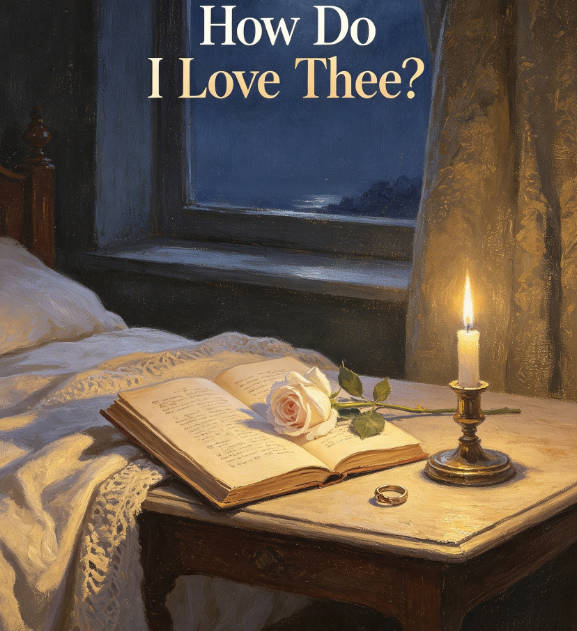
How Do I Love Thee? (Sonnet 43)
Elizabeth Barrett Browning · 1850 · Petrarchan sonnet
How do I love thee? Let me count the ways. I love thee to the depth and breadth and height My soul can reach, when feeling out of sight For the ends of being and ideal grace. I love thee to the level of every day's Most quiet need, by sun and candle-light. I love thee freely, as men strive for right; I love thee purely, as they turn from praise. I love thee with the passion put to use In my old griefs, and with my childhood's faith. I love thee with a love I seemed to lose With my lost saints. I love thee with the breath, Smiles, tears, of all my life; and, if God choose, I shall but love thee better after death.
Meaning
A love poem structured as an inventory: the speaker counts the ways she loves, and the counting itself becomes proof that love exceeds any final number.
Analysis
The opening question is rhetorical, but the poem takes it literally — it counts. Each 'I love thee' is a new measurement: spatial, daily, political, spiritual, temporal. The anaphora builds a catalog that feels both exhaustive and incomplete.
The volta arrives at 'I love thee with the passion put to use / In my old griefs'. Love is not separate from pain; it reuses the same intensity once spent on suffering. This is not sentimental love but love that has survived and repurposed damage.
The final line breaks the counting frame entirely. The poem has been measuring love in life; the last line promises it will continue 'after death', which means the inventory was never the point — it was a way of showing that love outstrips any scale used to weigh it.
Craft notes for your own writing
- Use anaphora — repeating a phrase — to build emotional momentum.
- Frame a love poem as a list to make excess feel structured.
- Break your own frame at the end; let the final line exceed the pattern.