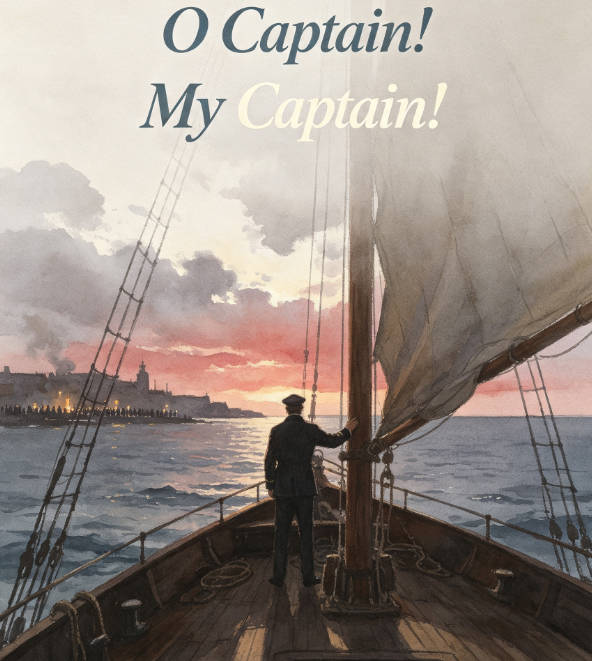
O Captain! My Captain!
Walt Whitman · 1865 · Three stanzas, extended metaphor
O Captain! my Captain! our fearful trip is done, The ship has weather'd every rack, the prize we sought is won, The port is near, the bells I hear, the people all exulting, While follow eyes the steady keel, the vessel grim and daring; But O heart! heart! heart! O the bleeding drops of red, Where on the deck my Captain lies, Fallen cold and dead. O Captain! my Captain! rise up and hear the bells; Rise up—for you the flag is flung—for you the bugle trills, For you bouquets and ribbon'd wreaths—for you the shores a-crowding, For you they call (the swaying mass) their eager faces turning; Here Captain! dear father! This arm beneath your head! It is some dream that on the deck, You've fallen cold and dead. My Captain does not answer, his lips are pale and still, My father does not feel my arm, he has no pulse nor will, The ship is anchor'd safe and sound, its voyage closed and done, From fearful trip the victor ship comes in with object won; Exult O shores, and ring O bells! But I, with mournful tread, Walk the deck my Captain lies, Fallen cold and dead.
Meaning
An elegy for Abraham Lincoln, written as a sailor addressing a fallen captain: the ship has won its war, but the man who steered it through the storm did not live to see port.
Analysis
Whitman stages the poem at the exact moment of contradiction: victory and grief arrive simultaneously. The bells ring, the crowds cheer, but the captain is dead on the deck. The poem's emotional pressure comes from holding both truths in the same stanza without letting either cancel the other.
The repeated cry — 'O heart! heart! heart!' — breaks the poem's formal surface. Whitman, who usually wrote in free verse, chose conventional meter and rhyme for this elegy, as though the structure were a container for grief that would otherwise spill.
The second stanza's denial — 'It is some dream' — is the poem's most human moment. The speaker knows the captain is dead, but the body refuses the knowledge. The third stanza accepts it: 'My Captain does not answer'. The poem traces the arc from disbelief to recognition.
Craft notes for your own writing
- Hold two contradictory emotions in the same scene without resolving them.
- Let a repeated cry break the poem's surface to show raw feeling.
- Use an extended metaphor to make a public grief feel personal.