Ozymandias
Percy Bysshe Shelley · 1818 · Sonnet, irregular rhyme
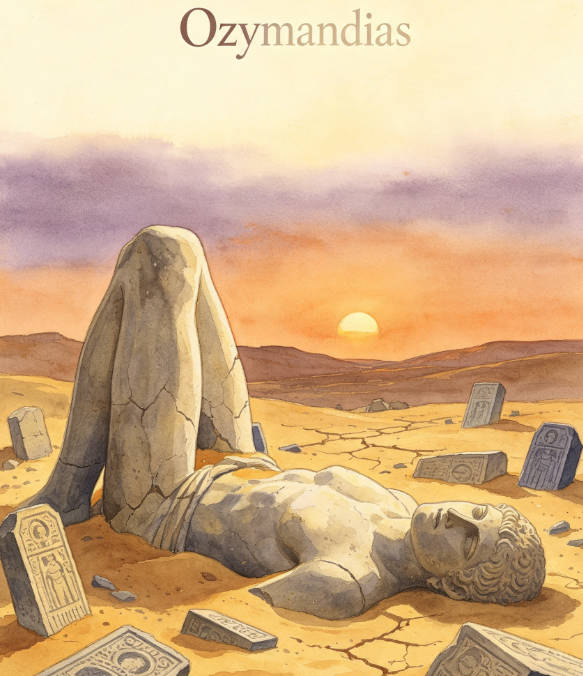
I met a traveller from an antique land, Who said—"Two vast and trunkless legs of stone Stand in the desert. . . . Near them, on the sand, Half sunk a shattered visage lies, whose frown, And wrinkled lip, and sneer of cold command, Tell that its sculptor well those passions read Which yet survive, stamped on these lifeless things, The hand that mocked them, and the heart that fed; And on the pedestal, these words appear: My name is Ozymandias, King of Kings; Look on my Works, ye Mighty, and despair! Nothing beside remains. Round the decay Of that colossal Wreck, boundless and bare The lone and level sands stretch far away."
Meaning
A political sonnet about the self-defeating nature of power: the king who demanded awe left behind only a monument to the futility of monuments.
Analysis
Shelley frames the poem through two intermediaries — the speaker quotes a traveller who quotes an inscription. Each layer distances the reader from the king's voice, so by the time we reach the boast, it arrives already surrounded by silence.
The sculptor is the poem's quiet hero. The king's passions survive only because the artist 'mocked them' — the word carries both 'imitated' and 'ridiculed' — meaning the monument was always a critique disguised as flattery.
The final three lines are pure landscape. No commentary, no moralising; just sand. The boundless emptiness is the argument, and it is stronger than any statement about hubris could be.
Craft notes for your own writing
- Frame a story through a narrator who quotes another narrator to create distance.
- Let the landscape deliver the moral instead of stating it.
- Use a boast to damn the boaster; the inscription is the poem's sharpest irony.