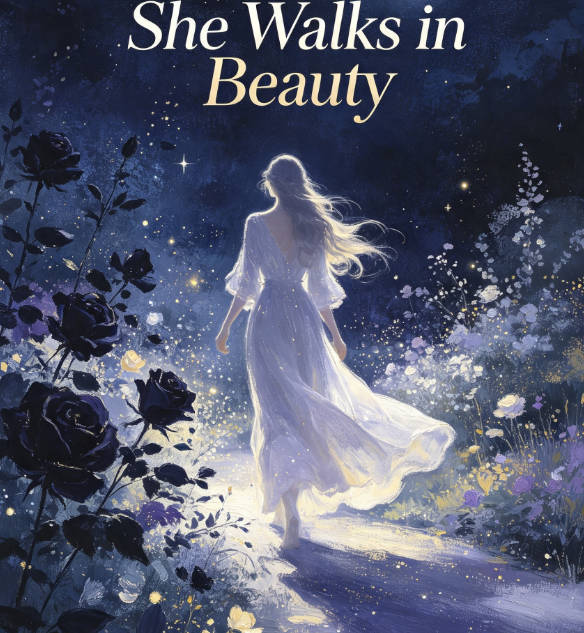
She Walks in Beauty
Lord Byron · 1814 · Three stanzas, ABABAB
She walks in beauty, like the night Of cloudless climes and starry skies; And all that's best of dark and bright Meet in her aspect and her eyes; Thus mellowed to that tender light Which heaven to gaudy day denies. One shade the more, one ray the less, Had half impaired the nameless grace Which waves in every raven tress, Or softly lightens o'er her face; Where thoughts serenely sweet express, How pure, how dear their dwelling-place. And on that cheek, and o'er that brow, So soft, so calm, yet eloquent, The smiles that win, the tints that glow, But tell of days in goodness spent; A mind at peace with all below, A heart whose love is innocent!
Meaning
A love poem that never mentions love directly: the beloved's beauty is described entirely through the balance of light and dark, and her moral goodness is read from her face.
Analysis
Byron opens with a simile that compares a woman to night — not to day, not to sunrise, but to darkness. The choice is the poem's first surprise: beauty here is not brightness but the meeting point of dark and bright, and the night sky is the only thing large enough to hold both.
The second stanza turns the metaphor into a mathematical argument: 'one shade the more, one ray the less' would ruin the balance. Byron treats beauty as a calibration so precise that a single photon either way would undo it, which is a way of saying the woman is perfect without using the word.
The final stanza shifts from appearance to character. The smiles and tints are read as evidence of 'a mind at peace' and 'a heart whose love is innocent'. The poem's quiet claim is that outer beauty, when genuine, is a surface expression of inner goodness — not a separate thing.
Craft notes for your own writing
- Compare your subject to something unexpected — night, not day — to force the reader to see them fresh.
- Frame beauty as a balance of opposites rather than a single quality.
- Let physical description carry a moral argument without stating it.