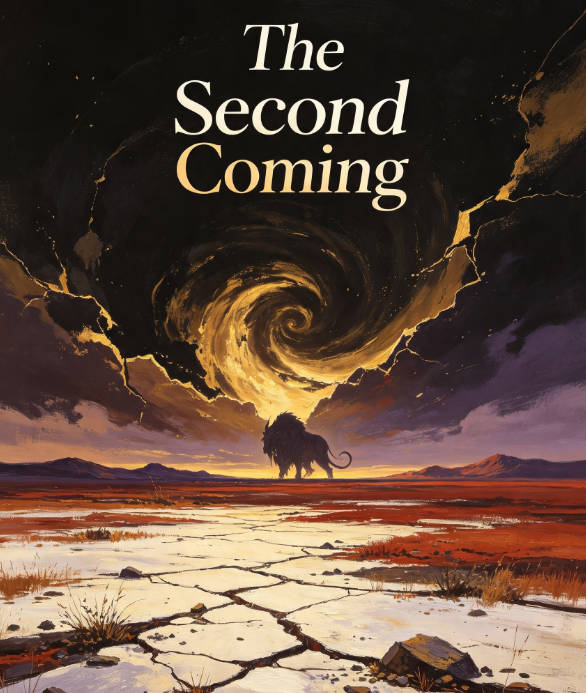
The Second Coming
W. B. Yeats · 1919 · Two stanzas, free verse
Turning and turning in the widening gyre The falcon cannot hear the falconer; Things fall apart; the centre cannot hold; Mere anarchy is loosed upon the world, The blood-dimmed tide is loosed, and everywhere The ceremony of innocence is drowned; The best lack all conviction, while the worst Are full of passionate intensity. Surely some revelation is at hand; Surely the Second Coming is at hand. The Second Coming! Hardly are those words out When a vast image out of Spiritus Mundi Troubles my sight: somewhere in sands of the desert A shape with lion body and the head of a man, A gaze blank and pitiless as the sun, Is moving its slow thighs, while all about it Reel shadows of the indignant desert birds. The darkness drops again; but now I know That twenty centuries of stony sleep Were vexed to nightmare by a rocking cradle, And what rough beast, its hour come round at last, Slouches towards Bethlehem to be born?
Meaning
Written after the First World War and during a pandemic, a poem arguing that civilisation is not declining — it is being replaced by something that does not yet have a name.
Analysis
The opening image — a falcon spiralling out of earshot of its handler — is the poem's thesis in miniature: the systems that once connected authority to action have broken, and what remains is uncontrolled motion.
'The best lack all conviction, while the worst / Are full of passionate intensity' is the line most quoted because it names a political pattern that has never stopped recurring. Yeats is not describing one crisis but a recurring shape.
The beast slouching towards Bethlehem is not the Christian Second Coming but its inversion. Yeats replaces the expected saviour with something pitiless and unknowable, and the poem ends on a question because the new thing has not fully arrived.
Craft notes for your own writing
- Open with a physical image that contains the entire argument.
- Quote your own title back at yourself to expose its inadequacy.
- End on a question when the thing you are describing is still arriving.