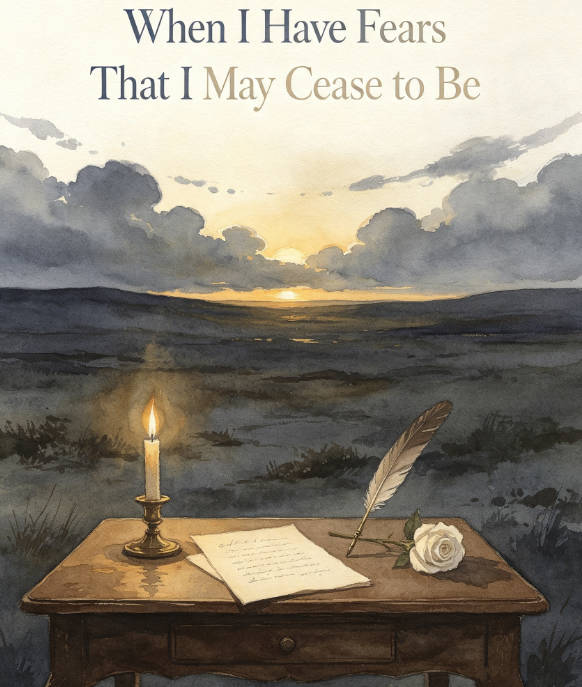
When I Have Fears That I May Cease to Be
John Keats · 1818 · Shakespearean sonnet
When I have fears that I may cease to be Before my pen has gleaned my teeming brain, Before high-piled books, in charactery, Hold like rich garners the full ripened grain; When I behold, upon the night's starred face, Huge cloudy symbols of a high romance, And think that I may never live to trace Their shadows, with the magic hand of chance; And when I feel, fair creature of an hour, That I shall never look upon thee more, Never have relish in the faery power Of unreflecting love—then on the shore Of the wide world I stand alone, and think Till love and fame to nothingness do sink.
Meaning
A poem about the fear of dying before one's work is done — and the quiet discovery that, faced with the scale of death, both ambition and love lose their grip.
Analysis
Keats builds the sonnet from three 'when' clauses, each naming a different thing death would steal: unwritten books, untraced romance, unfulfilled love. The structure simulates the mind circling the same anxiety from different angles.
The volta arrives at 'then on the shore / Of the wide world I stand alone'. The shore image is vast and indifferent, and standing on it, the speaker's fears undergo a strange transformation. They do not resolve; they shrink.
The final couplet does not console. Love and fame 'sink to nothingness' — not because they are worthless, but because the perspective death forces makes them small. The poem is honest about how little comfort that perspective provides.
Craft notes for your own writing
- Use repeated conditional clauses ('when I...') to build anxiety through accumulation.
- Introduce a vast image near the end to change the scale of the speaker's fear.
- Do not resolve the fear; let it diminish without disappearing.